 CARTANO
Canvases · Data model
An ERD tool online, in crow's foot or Chen notation
The Cartano Data Modeler draws a data model in your browser and shows it in the notation you choose: crow's foot, Merise (min,max), UML, IDEF1X, Chen or relational (Codd). Only one piece of data is stored, the participation at each end of a link, so changing notation does not mean redrawing. The PostgreSQL script and the data contract are derived from it.
What an ERD settles
A data model says where each piece of data lives, how it relates to the others, and how many times: a customer places zero or more orders, an order has one and only one customer. In French-speaking countries this is often called an MCD (conceptual data model, in the Merise method); elsewhere, an ERD (entity relationship diagram). It is the same family of drawings with different graphical conventions.
The choice of notation is often a matter of habit: Merise in French teaching and in many French IT departments, crow's foot among relational database designers.
How it works in Cartano
You place entities and typed attributes, one primary key per entity, and link them with foreign keys. Each link carries a cardinality, (0,1), (1,1), (0,n) or (1,n), at each end. The line is derived from the attribute's “link” field: you do not draw it separately.
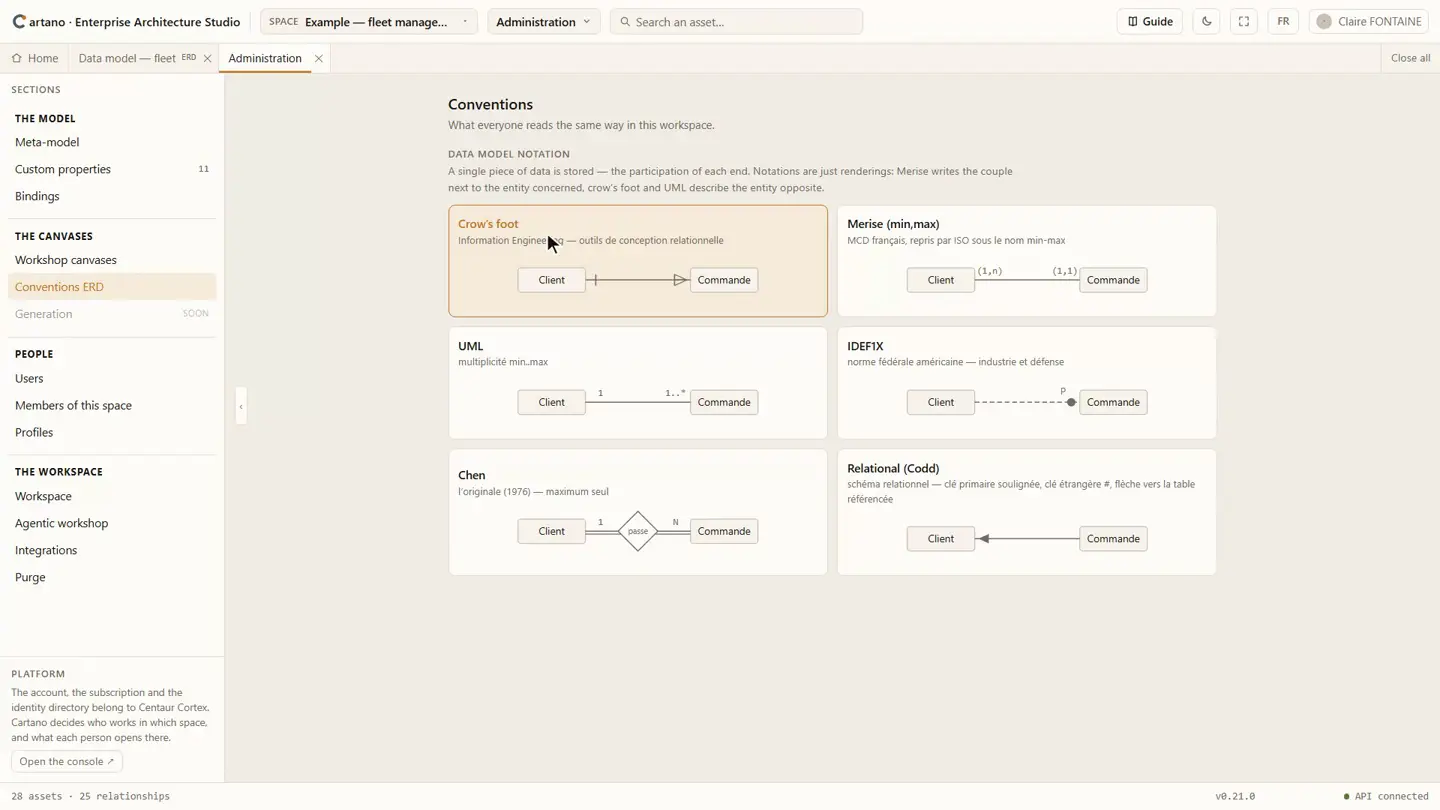
The notation is a workspace setting (Administration, “Conventions ERD”), with a preview of each of the six:
- crow's foot (Information Engineering);
- Merise (min,max): the pair is written next to the entity concerned;
- UML: multiplicities such as 1..*;
- IDEF1X;
- Chen, the original of 1976;
- relational (Codd): primary key underlined, foreign key, arrow towards the referenced table.
From drawing to SQL script and data contract
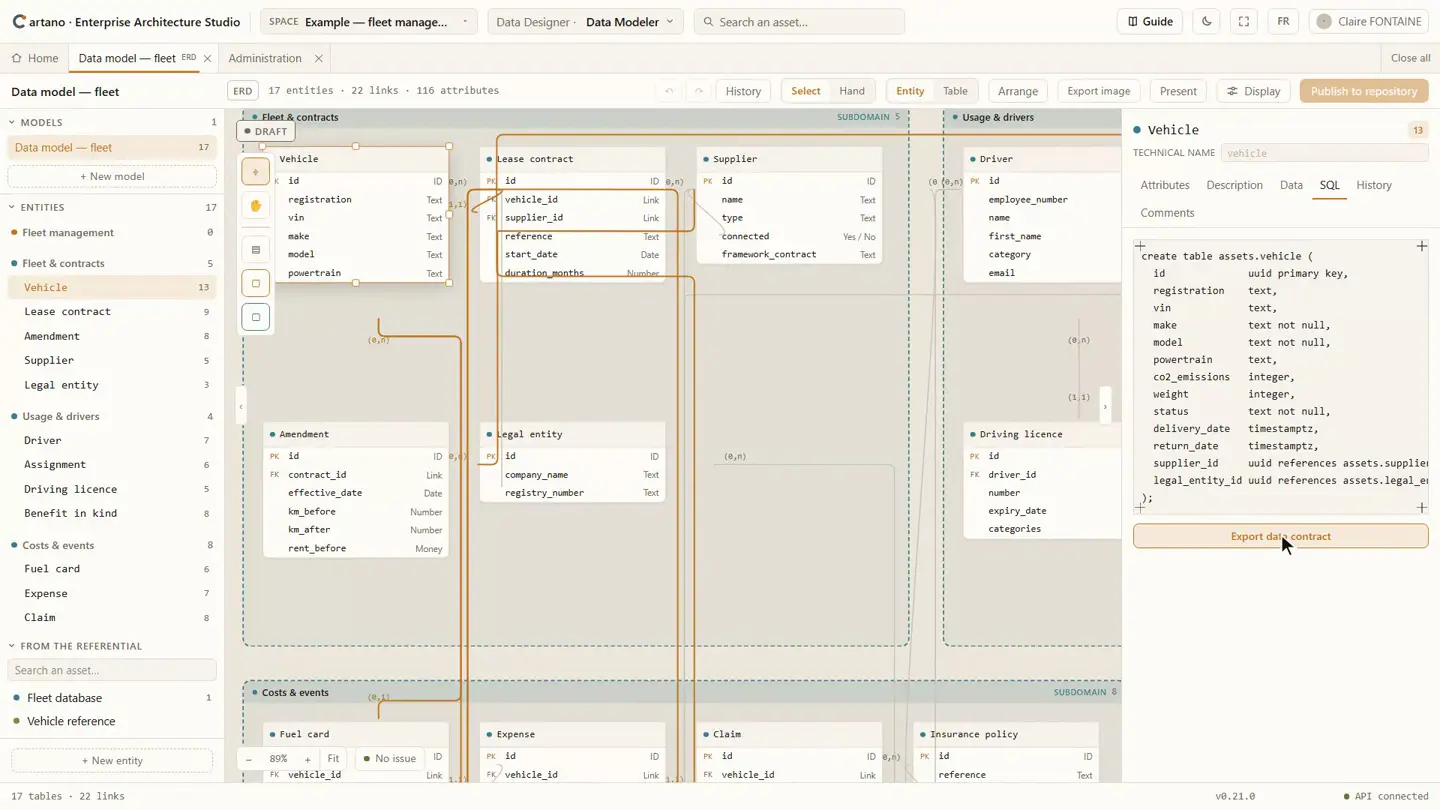
The SQL script is derived from the model, never retyped: a table's SQL tab gives the create table with types, primary key, required columns (not null) and foreign keys. A domain becomes a database, a sub-domain a schema. The dialect is PostgreSQL.
The same model exports as a data contract in the Data Contract Specification format (version 1.1.0, in YAML), which describes the models, fields, keys and references.
What you can bring in, and what comes out
A Hackolade model (.hck.json file) can be imported: collections become entities, properties become attributes, relationships become links. The import is simulated and reviewed before anything is written.
The diagram exports as an image (PNG or SVG), and the document can be committed to a Git repository, with the data contract alongside.
Frequently asked questions
What is an MCD?
A conceptual data model describes the entities of a domain, their attributes and the associations between them with their cardinalities, in the Merise method. Outside France it is usually called an ERD (entity relationship diagram).
What is the difference between MCD, MLD and MPD?
They are three levels of Merise: conceptual (MCD, entities and associations), logical (MLD, relational tables) and physical (MPD, types and the chosen DBMS). Cartano does not offer the three levels: its Data Modeler holds a physical model (tables, columns, keys) that it displays in Merise notation or another.
Merise or crow's foot: which notation should I use?
Merise (min,max) writes cardinalities as pairs next to the entity and dominates French teaching. Crow's foot draws “many” as a trident and reads at a glance; it is the most common for designing a relational database. Both work; Cartano lets you switch without redrawing.
Can I generate the SQL script?
Yes, in PostgreSQL: create table, types, primary key, not null and foreign keys, one script per database with a schema per sub-domain. Indexes and unique constraints are not generated.
Can I change notation without redrawing?
Yes. Cartano stores only the participation at each end of a link (0 or 1 at minimum, 1 or n at maximum); the six notations are renderings of that data. The setting applies per workspace.
Can I import a Hackolade model?
Yes, a .hck.json file: collections become entities, properties become attributes and relationships become links. The import is simulated and reviewed before writing.
Watch it run, rather than read about it.
A 30-day trial with no credit card on the Solo and Atelier plans. Or thirty minutes of demo, on your own cases.